


[Seoul=RNX News] Reporter Kim Ye-eun = Actress Han Hyo-joo took on the narration for KBS’s special project ‘Transhuman’ Part 2 ‘Brain Implant’, focusing on the ‘BCI technology’ revolution that big tech companies are eyeing, which connects the brain and computer.
It captures not only explanations from world-renowned scholars but also moments of daily recovery experienced by BCI clinical trial participants.
On November 19th (Wednesday), KBS’s special project ‘Transhuman’ Part 2 ‘Brain Implant’ aired, concentrating on the future that the technology ‘Brain-Computer Interface (BCI)’, which directly connects the human brain and computer, will open up.
BCI, which began as a medical technology for daily recovery, is undergoing continuous innovation with related technologies being announced by ‘Tesla·SpaceX founder’ Elon Musk, ‘NVIDIA CEO’ Jensen Huang, and ‘Meta CEO’ Mark Zuckerberg.
Additionally, it is a technology that has garnered attention from big tech and venture capital, with investments from ‘Amazon founder’ Jeff Bezos and ‘Microsoft founder’ Bill Gates.
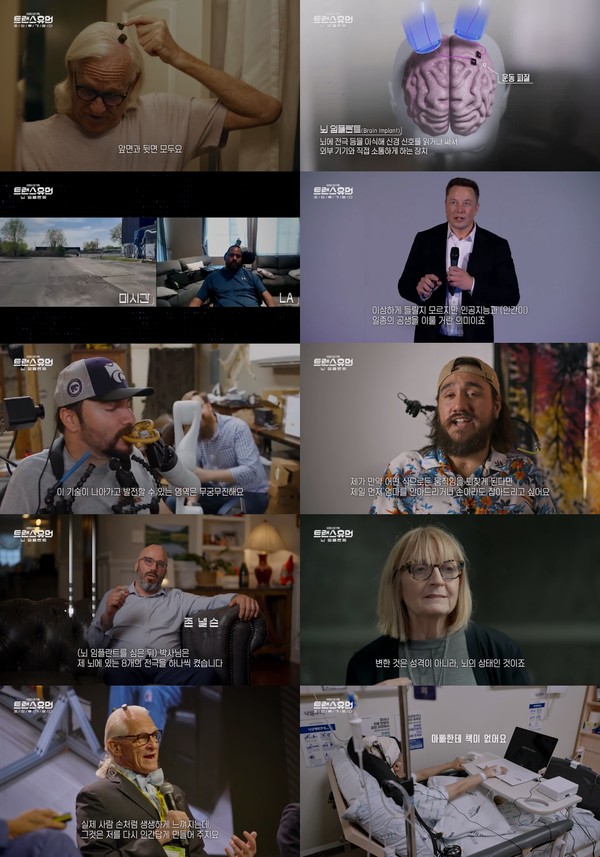
The Transhuman production team focused on the remarkable cases of BCI clinical trial participants Scott Imbrie and James Johnson. Also, for the first time on broadcast, it captured the daily life of the first clinical trial participant of BCI company ‘Neuralink’, co-founded by Elon Musk and Korean-American Dr. Dongjin Seo.
Elon Musk made an ambitious announcement saying, “It may sound strange, but AI and humans will achieve a sort of symbiosis.”
Neuralink has progressed from existing BCI technology that exposed external connection devices to miniaturizing implants to the size of a coin. It also implemented a high-density electrode that is 10 times denser than before on ultra-thin wires that are one-tenth the size of a human hair, causing a stir.
Noland Arbo, the first clinical trial participant of Neuralink in the U.S., was paralyzed below the neck due to a diving accident. He amazed many by activating or charging the BCI implants implanted in his brain with a wireless induction charger and moving freely without spatial constraints in a world connected by wireless Bluetooth technology.
The current 8th participant of Neuralink has shown progress in controlling a robotic arm wirelessly. Noland Arbo stated with a smile, “If I regain movement in any way, the first thing I would like to do is hug my mom or at least hold her hand.”
Narrator Han Hyo-joo delivered a hopeful message saying, “Technology helps them escape the limits of a paralyzed body.”
Another BCI clinical trial participant, James Johnson, who was diagnosed with quadriplegia, made headlines by operating a golf cart 3,000 km away with just his thoughts. He is about to embark on a new adventure by implanting an additional four chips in his brain, connecting a total of six brain implants.
Scott Imbrie revealed, “It feels like a vibration, as if touching the (uneven) surface of denim,” stating that he can directly feel the sensations delivered to the robotic arm through brain implants via electric stimulation.
Han Hyo-joo added a serious tone to the narration saying, “For some, a strange and unfamiliar future might be frightening, but for others, it’s an invitation to a post-human era where humanity is restored.”
Benjamin Rapoport, who co-founded Neuralink, developed film-like brain implants. This brought a new innovation allowing BCI implants to be fitted through microsurgery of the skull without penetrating the brain.
Similarly, Korea recently developed an ‘ultra-thin flexible electrode’ that has been clinically applied to epilepsy patients. The Neuroscience Research Institute at Seoul National University is researching BCI technology that converts thoughts into computer-generated speech.
Experts, including Professor Kang Bong-kyun, a world-renowned scholar in the field of neural network research, are analyzing and exploring ‘the world of the brain’ to take on new challenges towards expanding human intelligence and an ‘era of post-human’.
Meanwhile, John Nelson, who experienced severe depression, regained a lively daily life that was unimaginable three years ago through a ‘brain deep stimulator’.
Mount Sinai Hospital in the U.S. has introduced a technology that implants a deep stimulator 8cm deep from the brain surface to stimulate the overactive brain region of depression patients.
Professor Helen Mayberg of the Department of Neurology at Mount Sinai School of Medicine explained, “People often think ‘it seems like my personality has changed’, but what has changed is not the personality, but the state of the brain.”
Han Hyo-joo posed an intriguing question, “Will humans, who have always lived with their bodies, become a new entity beyond the body?”
KBS’s special project ‘Transhuman’ trilogy, introducing the boundary between machines and humans through Han Hyo-joo’s warm voice, is broadcast every Wednesday night at 10 pm on KBS 1TV for three weeks starting from the 12th.
The last part ‘Genetic Revolution’, where science fiction stories have become a reality and a showcase of cutting-edge technology, will air on November 26th, Wednesday at 10 pm on KBS 1TV. (Photo provided = KBS 1TV ‘Transhuman’)
